


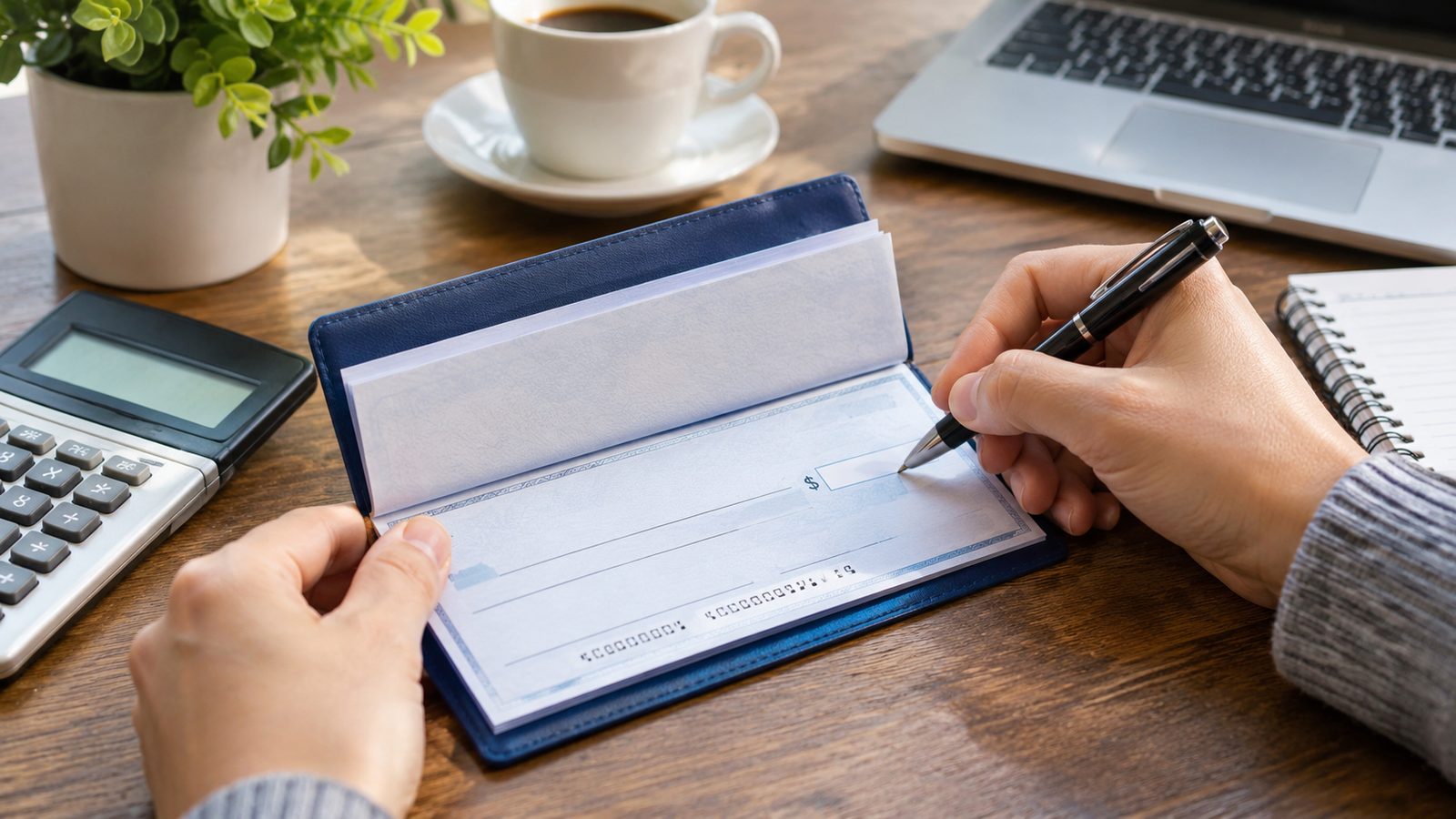
A check is a written payment instruction directing a bank to pay money from an account. In banking law, Regulation CC defines a check as a negotiable demand draft drawn on, or payable through, a bank. Checks remain useful for rent, business payments, large purchases, and transactions where electronic payment is unavailable. What is a check in practical terms? It tells a financial institution who should receive money and how much to pay. The payment usually comes from the writer’s checking account after the item is deposited or cashed.
| Check feature | What it does |
|---|---|
| Payee | Identifies the person or business receiving payment |
| Dollar amount | States how much should be paid |
| Routing number | Identifies the financial institution |
| Account number | Identifies the specific account |
| Check number | Helps track an individual check |
| MICR line | Contains machine-readable banking information |
| Signature | Authorizes the payment |
| Endorsement | Allows the recipient to deposit or negotiate the check |
What Is a Check Made Of?
A standard personal check contains information for both the payer and the banking system. Some details are written by the account holder, while others are preprinted. Understanding these fields helps prevent payment mistakes and exposes suspicious alterations more quickly. The routing number identifies the bank or credit union responsible for the account. Federal Reserve guidance on Regulation CC and check processing describes the routing number as a nine-digit number printed along the bottom of a check. That number helps route the item to the appropriate paying institution. The account number identifies the specific checking account that should fund the payment. Its length can vary between financial institutions. Because account numbers are sensitive, you should avoid exposing check images unnecessarily. The check number distinguishes one check from another within the same checkbook or account. It helps the account holder reconcile records and identify payments. The number commonly appears both near the top and within the bottom coding line. The MICR line appears along the bottom edge of many checks. MICR stands for magnetic ink character recognition. The Federal Reserve says this line may contain routing, account, check, amount, and other processing information.
Common Types of Checks
Not every check places the same payment risk on the recipient. The main differences involve who issues the instrument and whose funds support it. That distinction matters most for larger transactions.
| Payment type | Who provides the funds? | Typical use |
|---|---|---|
| Personal check | Individual or business account holder | Everyday payments |
| Cashier’s check | Issuing bank or credit union | Larger purchases |
| Certified check | Customer account with bank certification | Transactions requiring added assurance |
| Money order | Prepaid by purchaser | Payments without using a checking account |
Personal Checks
A personal check draws money from the writer’s checking account. Payment depends on sufficient available funds when the item reaches the paying bank. A personal check can therefore be returned unpaid. Business owners writing checks from a business account usually need the basics in place first, such as the business licensing and startup requirements Newsprend covers separately.
Cashier’s Checks
A cashier’s check is issued by a bank or credit union using the institution’s own obligation. The customer normally provides the funds before the bank issues the instrument. Recipients often request cashier’s checks for higher-value transactions because the issuing institution stands behind payment. A cashier’s check can still be counterfeit. Receiving one does not eliminate fraud risk. Unexpected checks should be verified before you send goods, return money, or transfer funds elsewhere.
Certified Checks
A certified check begins as a customer’s check, but the bank certifies it. Regulation CC says certification can confirm the drawer’s signature and the setting aside of funds. The bank may also certify that it will pay the item when presented. This differs from a cashier’s check because the underlying instrument comes from the customer’s account. The bank has added its certification to the payment. Availability and purchasing procedures can differ by institution.
Money Orders Compared With Checks
A money order is generally purchased in advance for a specified amount. That makes it different from a personal check drawn directly against a checking account. Money orders can help people make payments without revealing personal checking account information. Regulation CC includes certain U.S. Postal Service money orders within its legal check definition. Their deposit treatment can receive favorable availability rules when regulatory conditions are met. Those rules do not make every money order fraud-proof.
How Does a Check Clear?
When you deposit a check, your bank collects information from the item and sends it through the banking system. Modern processing often relies on electronic images rather than physically transporting the original paper. Check 21 rules allow qualifying substitute checks to have the same legal effect as originals. The depositary bank sends the item, or its electronic information, toward the paying bank. The paying bank determines whether the item can be honored against the writer’s account. Settlement between institutions then completes the payment process. A crucial distinction exists between funds availability and final payment. Your bank may let you withdraw deposited funds before it learns that a check is counterfeit or unpaid. The CFPB warns that customers can owe money back after depositing counterfeit checks or money orders.
Regulation CC and Check Deposit Holds
Regulation CC implements federal funds-availability requirements for many U.S. bank deposits. It establishes maximum hold periods rather than guaranteeing immediate access to every deposit. Banks may also provide faster availability than federal law requires. Since July 1, 2025, the first $275 of many qualifying check deposits must generally become available by the next business day. The Federal Reserve states that remaining local-check funds generally become available by the second business day. Federal Reserve guidance also notes that there are no longer nonlocal checks under the old processing-region framework. Certain Treasury, cashier’s, certified, government, and other qualifying checks may receive next-business-day availability when specific conditions are satisfied. Some require deposit in person to an employee and into the payee’s account. Deposits made through other methods can follow a different timetable. Regulation CC also permits longer holds in specified circumstances. These can include new accounts, repeated overdrafts, suspected uncollectible checks, emergencies, or unusually large deposits. The large-deposit threshold increased to $6,725 on July 1, 2025. Mobile deposit policies deserve separate attention. The CFPB notes that institutions may use different availability schedules for checks deposited through mobile banking. Check your bank’s disclosure before assuming photographed deposits follow teller-deposit timing.
How to Write a Check Correctly
Writing a check is simple when each field is completed carefully. Avoid leaving unnecessary blank spaces that someone could alter. Keep enough money in the account until the payment has fully posted.
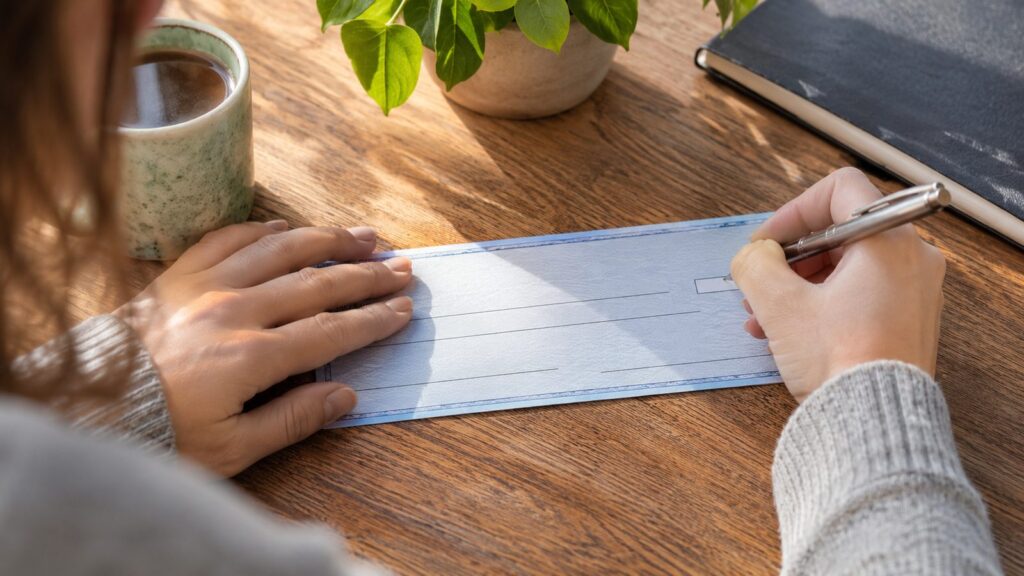
- Write the current date in the date field.
- Enter the recipient’s full name on the payee line.
- Write the payment amount numerically in the amount box.
- Write the same amount in words on the amount line.
- Add a memo when useful for invoices or records.
- Sign the check using your normal authorized signature.
- Record the payment so you can reconcile your account later.
If you make a major mistake, void the check and use another one. Do not sign a blank check for someone else to complete. CFPB guidance warns that protections may be limited when a signed blank check is later misused.
How to Endorse a Check
The recipient normally endorses a check on the back before depositing it. A basic endorsement usually consists of the payee’s signature in the designated endorsement area. Banks can impose additional instructions for mobile or restrictive deposits. A restrictive endorsement can limit how the item should be handled. For example, a bank may instruct mobile-deposit users to add wording identifying the mobile deposit. Follow the exact instructions shown by your financial institution. Avoid endorsing a check long before you are ready to deposit it. A signed item can become easier for another person to misuse if lost or stolen. Keep the document secure until the deposit is completed.
Check Fraud and Mail Theft Prevention
Check fraud includes stolen checks, altered payees, changed amounts, counterfeit instruments, and unauthorized checks created from account information. One common method is check washing, where criminals remove or alter ink on a legitimate check. The CFPB recommends black permanent marker or black gel ink because alteration can be more difficult. Mail theft creates another major risk. The CFPB fraud and scams guidance recommends taking outgoing checks directly to a post office instead of leaving them in a residential mailbox. It also advises retrieving incoming mail frequently and avoiding overnight mailbox storage. You should also monitor your account for checks you do not recognize. Report unauthorized or forged items to your bank or credit union promptly. The CFPB says protections may depend on how the item was processed and on applicable state law. Be cautious when a stranger sends a check for too much money. A common scam asks the recipient to deposit the item and return the “extra” amount. The original check may later prove counterfeit, leaving the recipient responsible for money already sent away.
Why the Federal Government Moved Away From Paper Checks
The federal government accelerated its transition away from paper checks in 2025. Executive Order 14247, signed March 25, 2025, directed federal agencies toward electronic payments and collections. Treasury describes the policy as applying to the extent permitted by law and recognizes limited exceptions. Treasury announced that the government would stop issuing paper checks for most federal payments on September 30, 2025. Examples included Social Security benefits, Veterans benefits, and other federal payments. The Bureau of the Fiscal Service also confirmed that most affected federal payments were required to move electronically on that date. The change did not mean that every paper Treasury check instantly became impossible. Treasury continued to describe limited exceptions and existing waiver procedures. Current Fiscal Service guidance says federal recipients generally receive payments electronically unless an applicable waiver exists. Fraud prevention was one reason for the transition. Fiscal Service says paper Treasury checks have been far more likely than electronic payments to face loss, theft, forgery, or related problems. Treasury has also cited continuing mail-theft-related check fraud in its federal payment guidance.
Frequently Asked Questions
What Is a Check Used For?
A check lets someone instruct a bank to transfer a specified amount to a recipient. People still use them for rent, contractors, business invoices, donations, and certain large purchases. Their use has declined as electronic payment methods have expanded.
Is Money Available as Soon as a Check Is Deposited?
Not necessarily. Federal availability rules determine when banks must release many deposits, but availability does not prove final payment. A deposited item can later be returned unpaid or identified as counterfeit.
Where Are the Routing and Account Numbers?
They normally appear along the bottom of a personal check within the MICR line. The routing number identifies the financial institution, while the account number identifies the account. The exact printed order can vary on some checks.
Can a Cashier’s Check Be Fake?
Yes. Criminals can create counterfeit cashier’s checks that look convincing. Verify suspicious instruments with the issuing institution using independently obtained contact information.
Should I Mail a Personal Check From My Home Mailbox?
The CFPB recommends taking checks directly to a post office instead. That reduces exposure to mailbox theft. Retrieve incoming mail frequently for the same reason.
The Bottom Line
Checks remain a functioning part of the U.S. payment system, even as electronic payments become more common. Knowing the numbers, endorsement rules, clearing process, and deposit timelines can prevent costly mistakes. Understanding fraud risks is equally important because visible account information can be misused. Business owners comparing funding options can also review Newsprend’s SBA loans versus Fundivi comparison, since banking, recordkeeping, and business payments often overlap. This article is general education, not financial advice. —
