


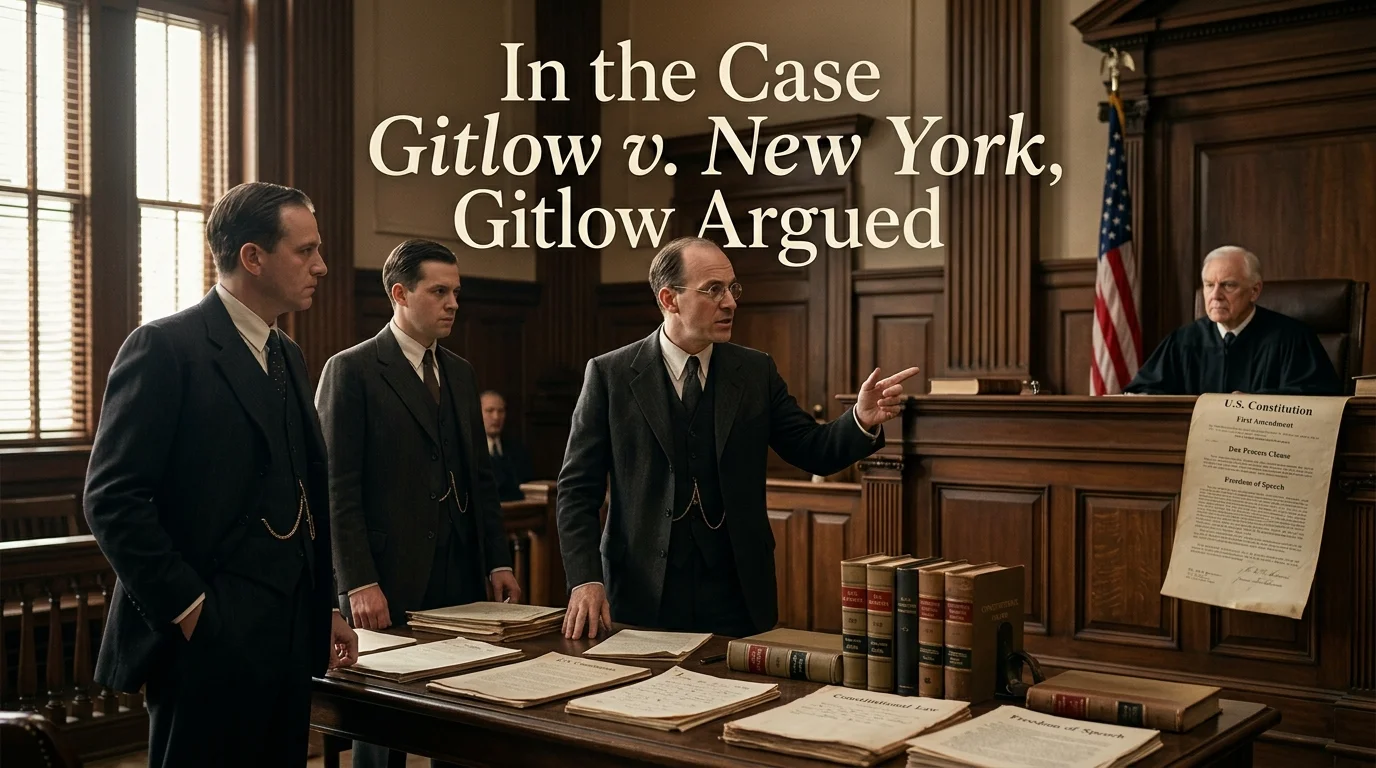
Short answer: In the case Gitlow v. New York, Gitlow argued that New York violated his First Amendment rights to freedom of speech and the press. He also argued that the Fourteenth Amendment’s Due Process Clause made those protections binding on the states and that his manifesto created no clear and present danger that justified punishment.
The Supreme Court accepted an important part of that constitutional reasoning but still upheld his conviction. That combination made the 1925 decision a major First Amendment case.
| Key fact | What to know |
|---|---|
| Case | Gitlow v. New York, 268 U.S. 652 |
| Decision date | June 8, 1925 |
| Main right involved | Freedom of speech and freedom of the press |
| Constitutional link | Fourteenth Amendment Due Process Clause |
| New York law | Criminal Anarchy Law |
| Supreme Court result | Gitlow’s conviction was upheld |
| Vote | 7 to 2 |
| Lasting importance | Free-speech protections became applicable to state governments |
The official United States Reports records the decision as Gitlow v. New York, 268 U.S. 652, decided on June 8, 1925.
What “In the Case Gitlow v. New York, Gitlow Argued” Means
Gitlow’s constitutional challenge can be reduced to three key points. They concerned First Amendment protections, the Fourteenth Amendment, and the lack of a concrete harmful result from his publication.
1. Freedom of Speech and the Press Protected His Political Expression
Benjamin Gitlow had helped publish and circulate the Left Wing Manifesto. New York prosecuted him under its Criminal Anarchy Law, which prohibited advocacy of the overthrow of organized government through force, violence, or other unlawful means.
His defense maintained that political expression could not be punished merely because the government considered its ideas dangerous—the argument centered on the First Amendment freedoms of speech and the press.
This is the simplest answer for students encountering the question on a quiz: Gitlow argued that New York was violating his First Amendment rights. Study resources addressing this query often reduce the answer to that point, although the full constitutional argument went further.
2. The Fourteenth Amendment Made Those Rights Relevant to New York
There was a major constitutional issue behind Gitlow’s First Amendment claim. The First Amendment expressly restricts Congress. His prosecution, however, came from the State of New York.
His lawyers relied on the Fourteenth Amendment to bridge that gap. They argued that the “liberty” protected by its Due Process Clause included freedom of speech and freedom of the press. If so, a state could not deprive a person of those freedoms without satisfying constitutional limits.
For purposes of the case, the Supreme Court’s opinion stated that it would assume that speech and press were fundamental liberties protected from state impairment by the Fourteenth Amendment. Later constitutional doctrine recognizes the case as incorporating the Free Speech Clause against the states.
That principle became far more important than the immediate result for Gitlow. The Federal Judicial Center describes the decision as the first time the Court applied the First Amendment to the states through the Fourteenth Amendment’s Due Process Clause.
3. His Publication Had Produced No Concrete Harmful Result
Gitlow also challenged the connection between his words and any real threat. The Supreme Court described his central contention in detail. His side argued that there was no evidence of a concrete result caused by the publication of the manifesto.
It also argued that expression concerning government should be punishable only when tied to a substantive evil that had occurred, had been attempted, or was sufficiently likely to occur.
In simpler terms, Gitlow’s position was that radical ideas alone were not enough. The state should have to show a meaningful connection between the speech and the danger it claimed to be preventing.
Why Was Benjamin Gitlow Prosecuted?
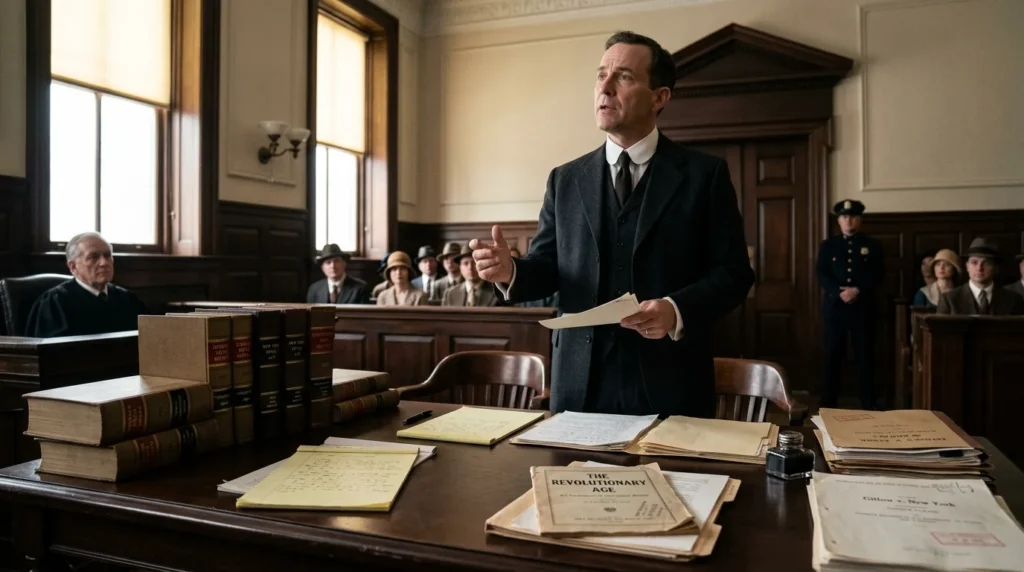
Gitlow was prosecuted for publishing and circulating the Left Wing Manifesto. The document supported revolutionary political change and discussed mass political and industrial action.
New York’s Criminal Anarchy Law made it a felony to advocate the overthrow of organized government through force, violence, or unlawful means. The state courts concluded that the manifesto fell within that prohibition.
The defense tried to distinguish political doctrine from a genuine call for immediate unlawful conduct. The Supreme Court majority disagreed. It concluded that the manifesto went beyond an abstract academic discussion and could be treated as advocacy of action.
The importance of reading the exact statute applies across legal subjects. NewsPrend uses the same statute-focused approach in its capital murder explainer, which stresses that legal labels depend on the governing jurisdiction and statutory language.
What Did the Supreme Court Decide?
The Supreme Court upheld Gitlow’s conviction by a 7- 2 vote. The majority accepted the constitutional importance of free speech but rejected the idea that the First Amendment created an unlimited right to publish any form of political advocacy.
The Court reasoned that New York need not wait until revolutionary advocacy produced an actual disturbance. Legislatures had room to act against speech they reasonably viewed as threatening organized government.
The contrast is easier to see side by side:
| Issue | Gitlow’s position | Supreme Court majority |
| First Amendment and states | Speech and press protected him through the Fourteenth Amendment | Accepted the constitutional connection |
| Nature of the manifesto | Political doctrine rather than punishable incitement | Treated it as advocacy of unlawful action |
| Evidence of harm | No concrete harmful result had occurred | New York did not have to wait for actual harm |
| Final result | Conviction should be reversed | Conviction affirmed |
So, Gitlow won recognition of an important constitutional principle but lost his own case.
Why Did Holmes and Brandeis Dissent?
Justices Oliver Wendell Holmes Jr. and Louis Brandeis disagreed with the majority’s treatment of the danger posed by Gitlow’s speech.
Holmes believed the conviction should be reversed because the manifesto presented no sufficiently immediate threat of an attempt to overthrow the government. His dissent emphasized the difference between expressing a radical idea and creating a present danger that could justify suppressing it.
That disagreement became significant as First Amendment doctrine developed. Later courts moved toward stronger protection for advocacy that does not threaten immediate unlawful action.
Readers interested in another NewsPrend article focused on individual legal protections can review its quid pro quo harassment and legal rights guide.
Why Gitlow v. New York Still Matters
The case’s lasting significance comes from its incorporation.
Before the incorporation doctrine developed, constitutional protections in the Bill of Rights did not automatically constrain state governments in the same way they constrained the federal government. The Gitlow decision helped change that approach for freedom of speech.
There is an important legal nuance. The 1925 opinion itself stated that it would “assume” that the First Amendment’s protections applied through the Fourteenth Amendment for purposes of the case. Later Supreme Court doctrine treats Gitlow as the decision that incorporated the Free Speech Clause.
The restrictive approach used to uphold Gitlow’s conviction did not remain the final standard for political advocacy. In Brandenburg v. Ohio in 1969, the Court held that states cannot punish advocacy of unlawful conduct unless it is directed toward producing imminent lawless action and is likely to produce it.
That modern rule is much more protective of political expression. For more plain-English explanations of legal concepts, readers can also browse NewsPrend’s Law section.
The Key Point to Remember
For a test or homework question, the clearest answer is that Gitlow argued that New York had violated his freedom of speech and freedom of the press. His deeper argument rested on the Fourteenth Amendment, which applied those protections to the states.
The Supreme Court agreed with the broader constitutional principle but ruled that New York could punish the advocacy involved in his case. That split result is why the decision occupies such an important place in American constitutional law.
Frequently Asked Questions
Gitlow argued that New York violated his First Amendment rights to freedom of speech and the press. His constitutional claim relied on the Fourteenth Amendment to make those protections applicable to state governments. He also argued that his publication had caused no concrete harm that warranted punishment.
Yes. More precisely, he argued that the Fourteenth Amendment’s protection of liberty included freedom of speech and the press. That made those First Amendment freedoms enforceable against New York.
No. The Supreme Court upheld his conviction. The case is still remembered as a major victory for the broader principle that constitutional free-speech protections limit state governments.
He was convicted under New York’s Criminal Anarchy Law. The law prohibited advocacy of the overthrow of organized government through force, violence, or unlawful means.
Remember two outcomes: Gitlow lost his appeal of the conviction, but the free-speech incorporation principle endured. That distinction explains why a defendant who lost his case still became associated with a major expansion of constitutional protection.
