



Letters testamentary are court-issued documents that authorize an executor to administer a deceased person’s estate. The probate court generally issues them after accepting the will and appointing the named executor. Banks, brokerages, insurers, and other institutions may request certified copies before allowing the executor to handle estate property.
Key Facts at a Glance
| Question | Answer |
| What are the letters? | Court-issued proof that an executor has authority to administer an estate |
| Who receives them? | Usually the executor named in a valid will |
| When are they issued? | After the probate court appoints and qualifies the executor |
| What do they authorize? | Estate administration, including handling assets and debts |
| What if there is no will? | The court generally issues letters of administration instead |
| Is the process the same nationwide? | No. Probate rules and procedures vary by state and court |
What Are Letters Testamentary?
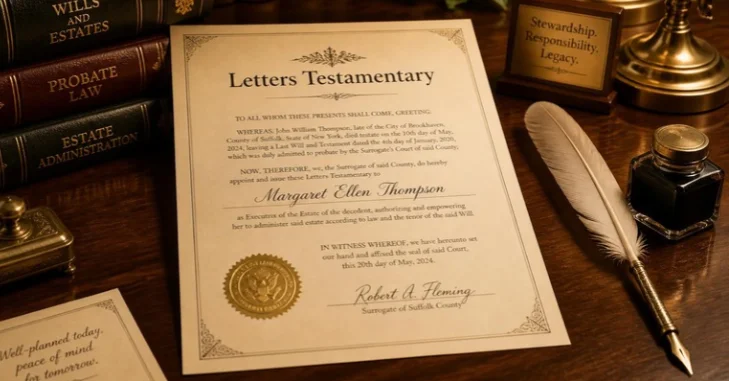
Letters Testamentary are official documents issued by a probate court. They provide formal evidence that the court has authorized the named executor to act on behalf of the estate and manage its affairs.
The document is different from the will itself. A will states the deceased person’s wishes and usually identifies the proposed executor, while the letters establish the executor’s court-recognized authority.
This distinction matters when dealing with third parties. A bank or title company may need proof of your authority before discussing accounts, transferring property, or completing other estate transactions.
What Do the Letters Allow an Executor to Do?
The precise powers depend on state law and the type of probate administration. In general, the document allows the appointed personal representative to conduct estate business within the authority granted by law and the court.
Typical responsibilities can include:
- Identifying and collecting estate assets.
- Opening or managing an estate bank account.
- Paying valid debts and estate expenses.
- Handling required tax matters.
- Protecting and managing estate property.
- Selling or transferring property when legally authorized.
- Distributing remaining assets to beneficiaries.
- Representing the estate in permitted legal matters.
Letters do not give an executor unlimited control over property. The executor remains subject to the will, state probate law, court orders, and fiduciary duties. Some transactions may require additional court approval or follow special state procedures.
How to Get Letters Testamentary
The process differs by state, but the basic sequence is similar. You generally need to begin a probate proceeding and establish that the will and proposed executor meet the applicable legal requirements.
1. Locate the original will
Start by finding the deceased person’s original will and any codicils. Courts may have specific rules when the original document cannot be located.
Also gather other estate records before filing. These may include a death certificate, asset information, beneficiary details, and documents identifying the deceased person’s residence.
2. File the probate petition
The proposed executor or their attorney files the required probate documents with the appropriate court. The correct court usually depends on the deceased person’s residence and state probate rules.
For example, North Carolina requires an application containing information about the deceased person, applicant, heirs, devisees, and known estate property.
3. Complete required notices and court procedures
Some jurisdictions require notice to heirs, beneficiaries, creditors, or other interested parties. The court may also schedule a hearing or review the filing without requiring a formal appearance.
The exact procedure depends on the state and the type of probate case. Follow the local court’s filing requirements rather than relying on another state’s process.
4. Qualify as executor
The proposed executor may need to complete an oath, provide additional documents, or satisfy other statutory requirements. Some states also require a bond unless the will or applicable law provides an exception.
Texas law, for example, provides that the court grants these letters to an executor appointed by the will who is not disqualified and is willing to accept and qualify.
5. Receive certified copies
Once the court appoints and qualifies the executor, the clerk issues the letters. It is often useful to obtain several certified copies because institutions may keep copies for their records.
The number needed depends on the estate. Ask the probate clerk how certified copies are issued and whether financial institutions require current copies.
How Long Does It Take to Get Letters Testamentary?
There is no single nationwide timeline. Court workload, filing requirements, notice periods, hearings, missing documents, and disputes can all affect when the letters are issued.
Straightforward uncontested cases can sometimes move within several weeks. Other estates may take several months before the executor receives formal authority, especially when the court requires additional procedures.
Texas law illustrates why state-specific research matters. Its statutes address when letters should be granted after a will has been probated and specify requirements for the issuance document.
A will contest can cause substantially greater delays. Missing heirs, questions about the original will, bond requirements, and incomplete filings can also slow the appointment process.
How Much Do the Letters Cost?
There is no standard U.S. price for obtaining them. The total expense usually depends on the probate court, estate size, filing requirements, certified copies, attorney involvement, and any required bond.
Court costs may include the probate filing fee and certified-copy charges. Attorney fees are separate and vary based on the estate and the services provided.
Because probate fees differ widely, avoid relying on a national price estimate. Check the current fee schedule for the court handling the estate, especially if the estate is being opened in a different state from your residence.
Letters Testamentary vs. Letters of Administration
The difference usually depends on whether the deceased person left a valid will and whether an executor can serve.
| Issue | Testamentary Letters | Letters of Administration |
| Will | Usually involves a valid will | Usually involves no will |
| Appointed person | Executor | Administrator |
| Court role | Confirms appointment and authority | Appoints a personal representative |
| Distribution | Usually follows the will and state law | Generally follows intestacy law |
| Common use | Testate estate | Intestate estate |
Courts and states may use different terminology for personal representatives. Minnesota, for example, defines them as court authorization to act as personal representative when there is a will.
North Carolina similarly distinguishes testamentary letters from letters of administration in its probate statutes.
Do You Need Court Letters If You Have a Will?
Having a will does not automatically give the named executor unrestricted authority over estate assets. The probate court generally must appoint the executor before the executor can exercise authority over the estate.
This is why institutions may ask for both the will and certified letters. The will identifies the deceased person’s wishes, while the court-issued document confirms the executor’s appointment.
Some states have exceptions and simplified procedures. Certain assets may also pass outside probate, meaning letters may not be necessary for every asset owned by the deceased.
What Happens After You Receive the Letters?
Receiving the letters is usually the beginning of estate administration rather than the end. The executor must still identify assets, address debts, follow tax requirements, and distribute property according to applicable law.
Keep organized records from the beginning. A simple estate file can track accounts, property, debts, notices, court documents, receipts, distributions, and correspondence with financial institutions.
You should also avoid distributing estate property too early. Creditors, taxes, expenses, and other legal obligations may need to be addressed before beneficiaries receive their final distributions.
For broader legal explainers, you can review Newsprend’s Law section. It provides additional coverage of general legal topics.
Common Mistakes Executors Should Avoid
Several mistakes can create unnecessary delays or legal problems during probate. Careful recordkeeping and attention to the court’s instructions can reduce these risks.
- Assuming the will alone proves current authority.
- Using another state’s probate forms.
- Failing to provide required notices.
- Losing track of estate expenses.
- Mixing estate funds with personal funds.
- Distributing assets before debts and required expenses are addressed.
- Assuming every estate asset must pass through probate.
- Relying on outdated online probate instructions.
State rules can change, and local courts may have their own filing practices. When the estate includes real property, business interests, disputes, substantial assets, or complicated tax issues, professional legal guidance may be appropriate.
Your Next Step as an Executor
If you have been named executor, start by identifying the probate court with jurisdiction over the estate. Gather the original will, death certificate, estate records, and information about heirs and beneficiaries before filing.
Then check the court’s current requirements rather than relying on a generic national checklist. If the estate involves disputes, multiple states, substantial property, business interests, or complex taxes, consider speaking with a qualified probate attorney before taking major actions.
Letters testamentary establish your formal authority, but they also begin a set of legal responsibilities. Treat the appointment as a fiduciary role, keep detailed records, and follow the probate rules that apply to the specific estate.
Frequently Asked Questions
What are letters testamentary?
They are court-issued documents confirming an executor’s authority to administer an estate. They are generally issued after the court accepts the will and appoints the executor.
How do I get the letters?
You generally begin by filing the will and required probate documents with the appropriate court. After the court completes its review and appoints and qualifies the executor, the clerk issues the letters.
Can you get the letters without probate?
Generally, they come from a probate court. However, some estates can use simplified procedures or avoid probate for particular assets, depending on state law.
How long does it take to receive the letters?
The timeline varies by state, county, court workload, and case complexity. An uncontested estate may move within weeks, while disputes or missing documents can cause longer delays.
How much do the letters cost?
Costs vary by jurisdiction and estate circumstances. Expenses can include court filing fees, certified-copy fees, attorney fees, and a bond when one is required.
What is the difference between testamentary letters and letters of administration?
Testamentary letters generally authorize an executor when a valid will is being administered. Letters of administration generally authorize an administrator when there is no will or when another statutory situation requires an administrator.
